No. 25-1083October Term 2025Decided June 25, 2026Updated Sep 14, 2026
Mullin v. Doe
Case status
Where it stands
Non-constitutional challenges to TPS decisions are barred from court review, and the constitutional challenge to Haiti's TPS termination is unlikely to prevail.
Decided 6-3 · June 25, 2026 · Opinion by Justice Alito
Read the opinion (PDF)- Also argued that day
What it's about
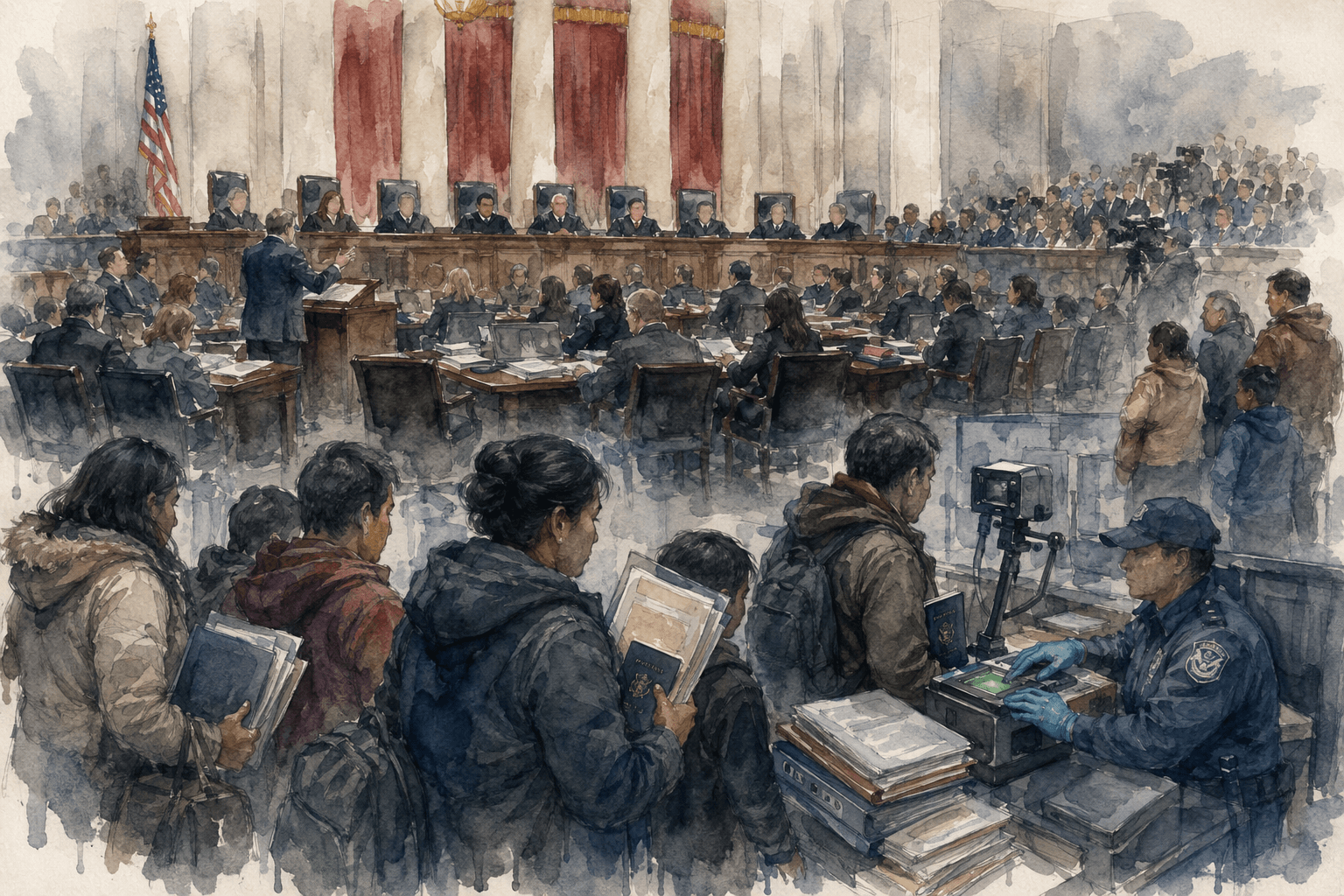
The Court ruled that the Temporary Protected Status statute prevents courts from hearing nonconstitutional challenges to the Homeland Security Secretary’s decisions to grant, extend, or end TPS, so the government prevailed on the respondents’ Administrative Procedure Act claims. The Court also concluded that the challenge alleging that Haiti’s TPS designation was ended because of race was unlikely to succeed, and it reversed and sent the case back to the lower court.
Question presented
1. Whether the judicial-review bar in the TPS statute, 8 U.S.C. 1254a(b)(5)(A), precludes respondents' APA claims? 2. If reviewable, whether respondents' APA claims nonetheless fail on the merits?
What the Court decided
Holding
The TPS statute bars judicial review of non-constitutional claims. Miot respondents’ equal protection claim is unlikely to succeed. Reversed and remanded.
- Result
- Reversed
Vote
- Vote split
- 6-3
- Majority author
- Samuel A. Alito, Jr.
- Barrett, with the majority
- Gorsuch, with the majority
- Sotomayor, dissenting
- Thomas, concurring, wrote the opinion
- Roberts, with the majority
- Alito, with the majority, wrote the opinion
- Kagan, dissenting, wrote the opinion
- Kavanaugh, with the majority
- Jackson, dissenting
- Majority
- Concurrence
- Dissent
From the opinions
“The Court considered whether a “discriminatory purpose [was] a motivating factor in the decision” to terminate Haiti’s TPS designation.”
What's next
Lower courts must apply the Court's decision on remand. Agencies and people affected by TPS decisions will face tighter limits on APA challenges, while constitutional claims remain subject to the Court's analysis.
Why it matters
The decision limits lawsuits using the Administrative Procedure Act (APA), a law governing federal-agency actions, to challenge TPS decisions. For example, people affected by the end of Haiti's TPS designation cannot use non-constitutional APA claims to seek court review.
The case addresses how much power federal courts have to review executive-branch decisions about TPS, a temporary immigration protection for people from designated countries.
Case file
Related cases
 Donald J. Trump, President of the United States, et al., Petitioners v. V.O.S. Selections, Inc., et al.Decided25-250Decided
 FTC removal protectionsDonald J. Trump, President of the United States v. Rebecca Kelly SlaughterDecided25-332Decided
 IEEPA tariffsLearning Resources, Inc., et al., Petitioners v. Donald J. Trump, President of the United States, et al.Decided24-1287Decided
 Geofence warrantsOkello T. Chatrie, Petitioner v. United StatesDecided25-112
Docket activity
AI analysis generated: Decision Record
AI analysis generated: Case Briefing
AI analysis generated: Impact Analysis
AI analysis generated: Opinion Summary
Opinion added: Opinion of the Court - A
Show all 10Show fewer
Court Order added: Main Document
Court Order added: Other
Audio Recording added: Oral Arguments - Mullin
Brief added: Reply
Brief added: Questions Presented
More questions
- What did the Supreme Court rule in Mullin v. Doe?
- The Court said the TPS statute bars review of non-constitutional claims. It also found the equal-protection challenge to Haiti's TPS termination unlikely to succeed.
- Who is affected by the TPS decision in Mullin v. Doe?
- People affected by Haiti's TPS termination and others challenging TPS decisions are affected. Non-constitutional APA claims cannot be used to obtain court review.
- What happens next after Mullin v. Doe?
- The case returns for further proceedings consistent with the Court's decision. Lower courts must enforce the limit on non-constitutional challenges to TPS actions.
Sources
Primary materials plus reporting. Best-effort analysis: this explainer relies on a mix of primary materials and trusted secondary sources. Official filings and opinions remain authoritative.