Hikma Pharmaceuticals USA v. Amarin Pharma
In brief
To pursue an active-inducement claim, Amarin needed to allege that Hikma actually encouraged the patented use, not simply that doctors might infer it from general statements.
- Where it stands
- Decided
Decided 9-0 · June 4, 2026 · Opinion by Justice Jackson
- What it’s about
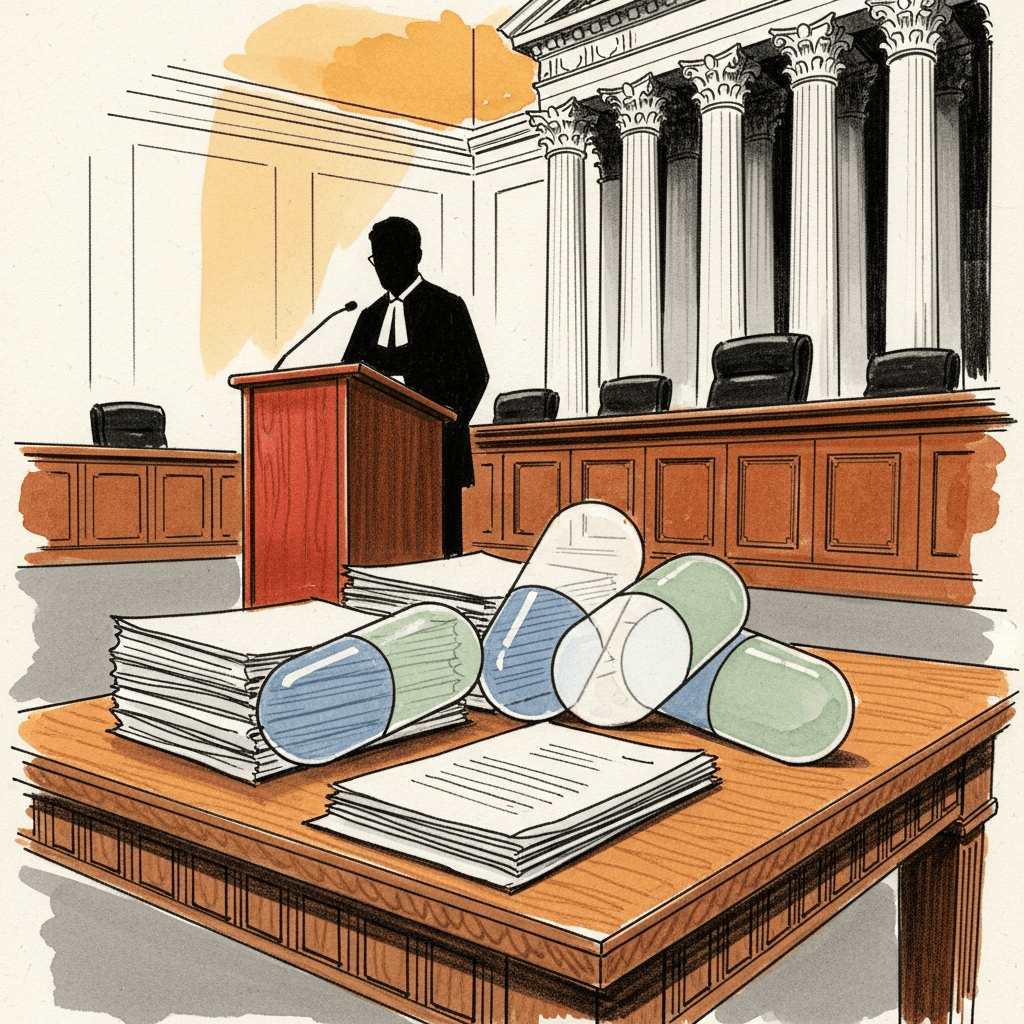
- The Court unanimously ruled for Hikma and held that Amarin’s complaint did not plausibly allege that Hikma actively encouraged doctors to use its generic drug in a way that infringed Amarin’s patent.
- Who it affects
- Generic drug companies have clearer limits on when marketing can trigger claims that they encouraged patent infringement.
Summary: written with AI from the case record.
What it's about
Routine generic-drug labeling, standard descriptions of the drug as equivalent to the brand product, and vague public statements did not amount to the affirmative encouragement required for inducement liability under federal patent law.
The decision addresses how patent law applies when generic medicines are marketed without a patented use listed on their labels.
Question presented
1. When a generic drug manufacturer excludes a patented use from its label, can it still be liable for inducing infringement if it calls its product a “generic version” of the brand-name drug and cites publicly available information about the brand-name drug’s sales? 2. Can a patent infringement complaint survive dismissal if it does not allege that the defendant made any statement specifically instructing or encouraging the patented use?
What the Court decided
The vote
From the opinions
““The central question is whether Amarin plausibly alleged that Hikma actively encouraged infringing use.””
What's next
The case returns to the Federal Circuit for further proceedings consistent with the Court's decision. Lower courts must apply the requirement that a complaint allege active encouragement of infringement.
Why it matters
For example, a company that removes a patented use from its label cannot be sued successfully based only on calling its product a generic version and citing public sales information.
Docket activity
Case data updated: summary, question_presented, generation_metadata
New analysis added
AI analysis generated: Case Briefing
New analysis added
AI analysis generated: Impact Analysis
Show 7 moreShow fewer
AI analysis generated: Opinion Summary
New analysis added
New analysis added
New analysis added
Opinion added: Opinion of the Court - KJ
Status changed from unknown to unknown
Audio Recording added: Oral Arguments - Hikma Pharmaceuticals USA Inc., et al., Petitioners v. Amarin Pharma, Inc., et al.
More questions
- What did the Supreme Court rule in Hikma v. Amarin?
- The Court unanimously ruled for Hikma. Amarin's complaint did not adequately allege that Hikma encouraged use of the patented treatment.
- How does Hikma v. Amarin affect generic drug companies?
- Generic manufacturers face less risk from claims based only on general references to brand-name drugs. Plaintiffs must allege statements actively encouraging patented uses.
- What happens next in Hikma v. Amarin?
- The case returns to the Federal Circuit. That court must handle the case consistently with the Supreme Court's ruling that the complaint cannot survive dismissal.
Sources
Primary materials plus reporting. Best-effort analysis: this explainer relies on a mix of primary materials and trusted secondary sources. Official filings and opinions remain authoritative.