Review of green card denials
Patel v. Garland
In brief
The Supreme Court upheld the lower-court ruling and said federal courts cannot review facts found in covered proceedings for discretionary immigration relief.
- Where it stands
- Decided
Decided 5-4 · May 16, 2022 · Opinion by Justice Barrett
- What it’s about
- This case is about whether federal courts can review an immigration agency’s factual finding that a noncitizen is ineligible to seek lawful permanent residence through adjustment of status.
- Who it affects
- The ruling leaves federal courts without power to review factual findings made during covered immigration proceedings.
Summary: written with AI from the case record.
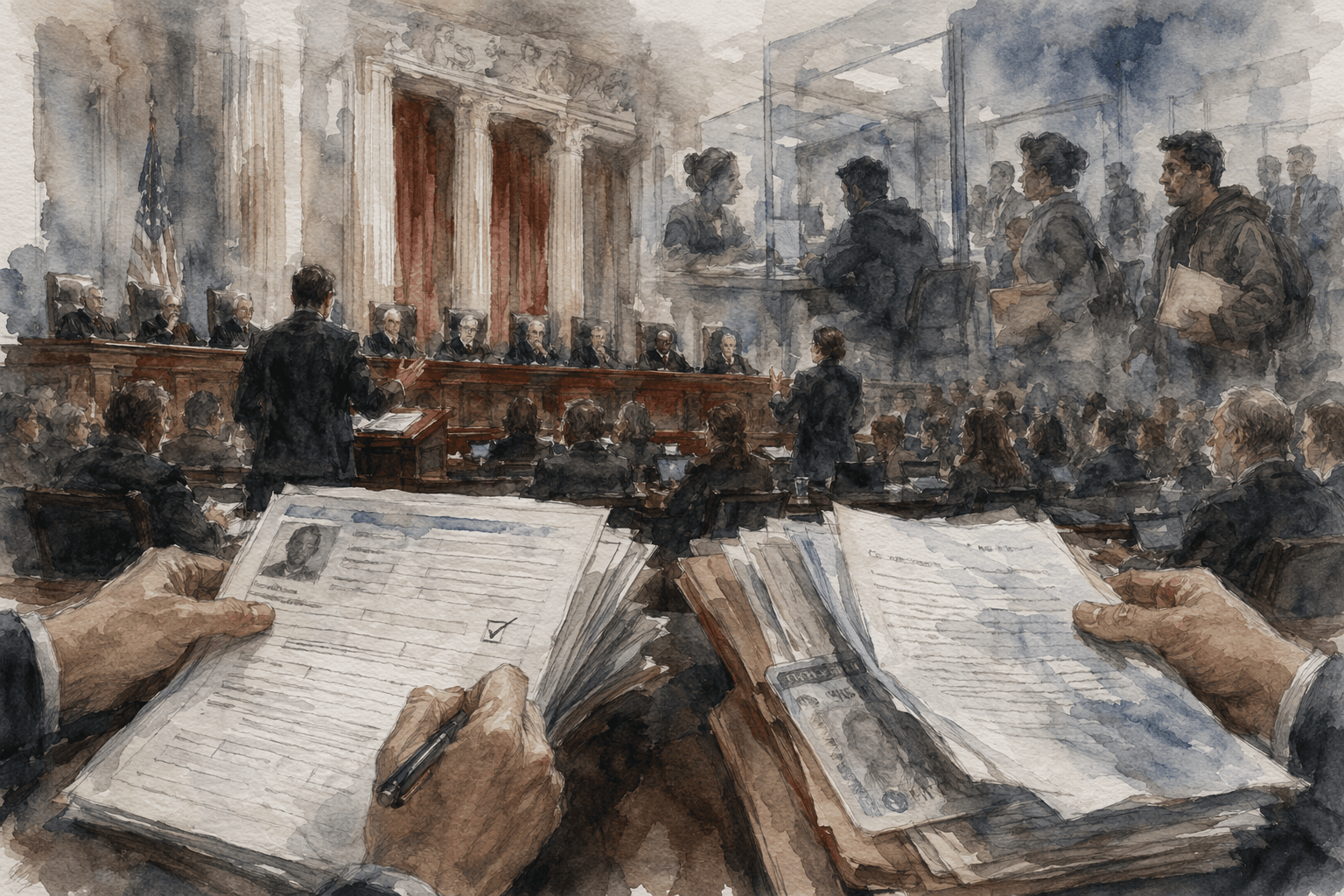
What it's about
Patel argued that he accidentally checked a box claiming U.S. citizenship on a Georgia driver’s license application, while the government treated that as a false citizenship claim that made him inadmissible.
The case sets a boundary on federal-court review of immigration decisions involving benefits that officials may choose to grant.
Question presented
1. Whether 8 U.S.C. § 1252(a)(2)(B)(i) preserves the jurisdiction of federal courts to review a nondiscretionary determination that a noncitizen is ineligible for certain types of discretionary relief. 2. Whether 8 U.S.C. § 1182(a)(6)(C)(ii), which renders a noncitizen inadmissible for "falsely represent[ing]'' oneself to be a U.S. citizen for a government benefit, applies to immaterial misrepresentations.
What the Court decided
Holding
Federal courts lack jurisdiction to review facts found as part of dis-cretionary-relief proceedings under §1255 and the other provisions enumerated in §1252(a)(2)(B)(i). 971 F. 3d 1258, affirmed.
- Result
- Affirmed
The vote
From the opinions
“Today, the Court holds that a federal bureaucracy can make an obvious factual error, one that will result in an individual’s removal from this country, and nothing can be done about it. No court may even hear the case.”
What's next
Lower courts and immigration authorities must apply this rule in proceedings covered by §1255 and the listed provisions of §1252(a)(2)(B)(i). The Eleventh Circuit’s ruling remains in place.
Why it matters
It does not separately resolve whether an immaterial (not outcome-changing) false claim of U.S. citizenship makes a noncitizen inadmissible (barred from admission).
Documents
Docket activity
New analysis added
AI analysis generated: Case Briefing
New analysis added
AI analysis generated: Impact Analysis
AI analysis generated: Opinion Summary
Show 5 moreShow fewer
AI analysis generated: Decision Record
Case data updated: status, opinion_date
Opinion added: opinion
Brief added: Petition
Brief added: Questions Presented
More questions
- What did Patel v. Garland decide?
- The Supreme Court upheld the Eleventh Circuit’s ruling. It said federal courts cannot review facts found in proceedings where officials may choose whether to grant immigration relief.
- What remains unresolved about Patel’s citizenship claim?
- The ruling does not separately answer whether an immaterial (not outcome-changing) false claim of U.S. citizenship makes a noncitizen inadmissible (barred from admission).
- How does the ruling affect federal-court review?
- It leaves federal courts without power to review facts found in proceedings covered by §1255 and the other listed provisions of §1252(a)(2)(B)(i).
- How did the justices divide in Patel?
- Justice Barrett wrote the Court’s opinion, and Chief Justice Roberts and Justices Thomas, Alito, and Kavanaugh signed on to it. Justice Gorsuch wrote a dissent (opinion disagreeing with the result), and Justices Breyer, Sotomayor, and Kagan signed on to that dissent.
- What happens next after the decision?
- Lower courts and immigration authorities must apply the rule in future proceedings under the listed provisions. The Eleventh Circuit’s ruling remains in place.
Sources
Primary materials plus reporting. Best-effort analysis: this explainer relies on a mix of primary materials and trusted secondary sources. Official filings and opinions remain authoritative.