Knick v. Township of Scott
In brief
The Court let property owners take federal takings claims to federal court right away instead of requiring a state-court compensation case first.
- Where it stands
- Decided
Decided 5-4 · June 21, 2019 · Opinion by Justice Thomas
- What it’s about
- After the Township of Scott required public access to cemeteries on private land, property owner Rose Mary Knick sued under a federal civil-rights law, claiming the ordinance took her property without compensation.
- Who it affects
- Property owners can now bring a Fifth Amendment takings claim in federal court when the government takes property without compensation. They no longer must first try to obtain payment through state court.
Summary: written with AI from the case record.
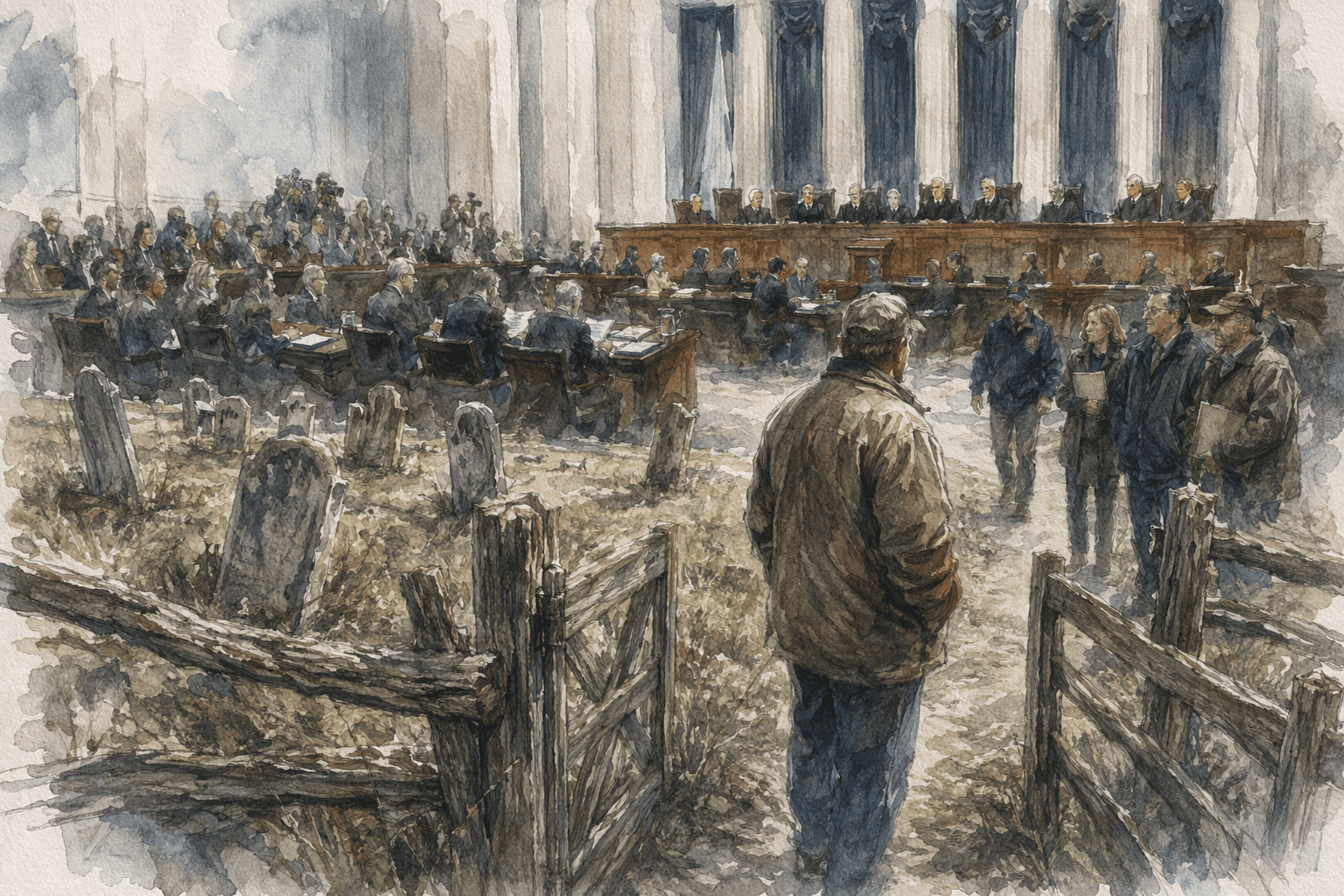
What it's about
The Supreme Court overturned the rule requiring her to seek payment in state court first, wiped out the Third Circuit’s judgment (vacated), and sent the case back for further proceedings (remanded), without finally deciding the ordinance’s effect.
The decision changed where property-rights disputes can begin by ending a 1985 rule that had steered many takings claims into state courts first.
Question presented
1. Whether the Court should reconsider the portion of Williamson County Regional Planning Commission v. Hamilton Bank, 473 U.S. 172, 194-96 (1985), requiring property owners to exhaust state court remedies to ripen federal takings claims, as suggested by Justices of this Court? See Arrigoni Enterprises, LLC V. Town of Durham, 136 S. Ct. 1409 (2016) (Thomas, J., joined by Kennedy, J., dissenting from denial of certiorari); San Remo Hotel, L.P. v. City and County of San Francisco, 545 U.S. 323, 348 (2005) (Rehnquist, C.J., joined by O'Connor, Kennedy, and Thomas, JJ., concurring in judgment). 2. Alternately, whether Williamson County's ripeness doctrine bars review of takings claims asserting that a law causes an unconstitutional taking on its face as the Sixth, Ninth, Tenth and now Third Circuits hold, or whether facial claims are exempt from Williamson County, as the First, Fourth, and Seventh Circuits hold?
What the Court decided
Holding
1. A government violates the Takings Clause when it takes property without compensation, and a property owner may bring a Fifth Amendment claim under §1983 at that time. 2. The state-litigation requirement of Williamson County is overruled. Several factors counsel in favor of this decision. Williamson County was poorly reasoned and conflicts with much of the Court’s takings jurisprudence. Because of its shaky foundations, the rationale for the state-litigation requirement has been repeatedly recast by this Court and the defenders of Williamson County . The state-litigation requirement also proved to be unworkable in practice because the San Remo preclusion trap prevented takings plaintiffs from ever bringing their claims in federal court, contrary to the expectations of the Williamson County Court. 862 F. 3d 310, vacated and remanded.
- Result
- Vacated
The vote
From the opinions
“Today, the Court formally overrules Williamson County Regional Planning Comm’n v. Hamilton Bank of Johnson City , 473 U. S. 172 (1985).”
What's next
The case returned to the lower court for further proceedings under the Court's new rule. The Court did not itself decide whether the township's cemetery-access rule required compensation.
Documents
Docket activity
New analysis added
AI analysis generated: Impact Analysis
AI analysis generated: Opinion Summary
Case data updated: summary, question_presented, generation_metadata
New analysis added
Show 5 moreShow fewer
AI analysis generated: Case Briefing
AI analysis generated: Decision Record
New analysis added
Opinion added: opinion
Brief added: Questions Presented
More questions
- What did Knick v. Township of Scott decide?
- The Court rejected the rule requiring property owners to seek compensation in state court before filing a federal takings claim.
- How did Knick change takings lawsuits?
- Owners may file a federal Fifth Amendment claim when the government takes property without compensation. They need not first pursue a state-court payment claim.
- Who was in the majority in Knick?
- Chief Justice Roberts wrote for five justices: Roberts, Thomas, Alito, Gorsuch, and Kavanaugh. Kagan dissented with Ginsburg, Breyer, and Sotomayor.
- What happens next in Knick v. Township of Scott?
- The Third Circuit must reconsider the case after the Supreme Court wiped out its earlier ruling. The ultimate compensation question remains for further proceedings.
Sources
Primary materials plus reporting. Best-effort analysis: this explainer relies on a mix of primary materials and trusted secondary sources. Official filings and opinions remain authoritative.