Religious flags on city flagpoles
Shurtleff v. Boston
In brief
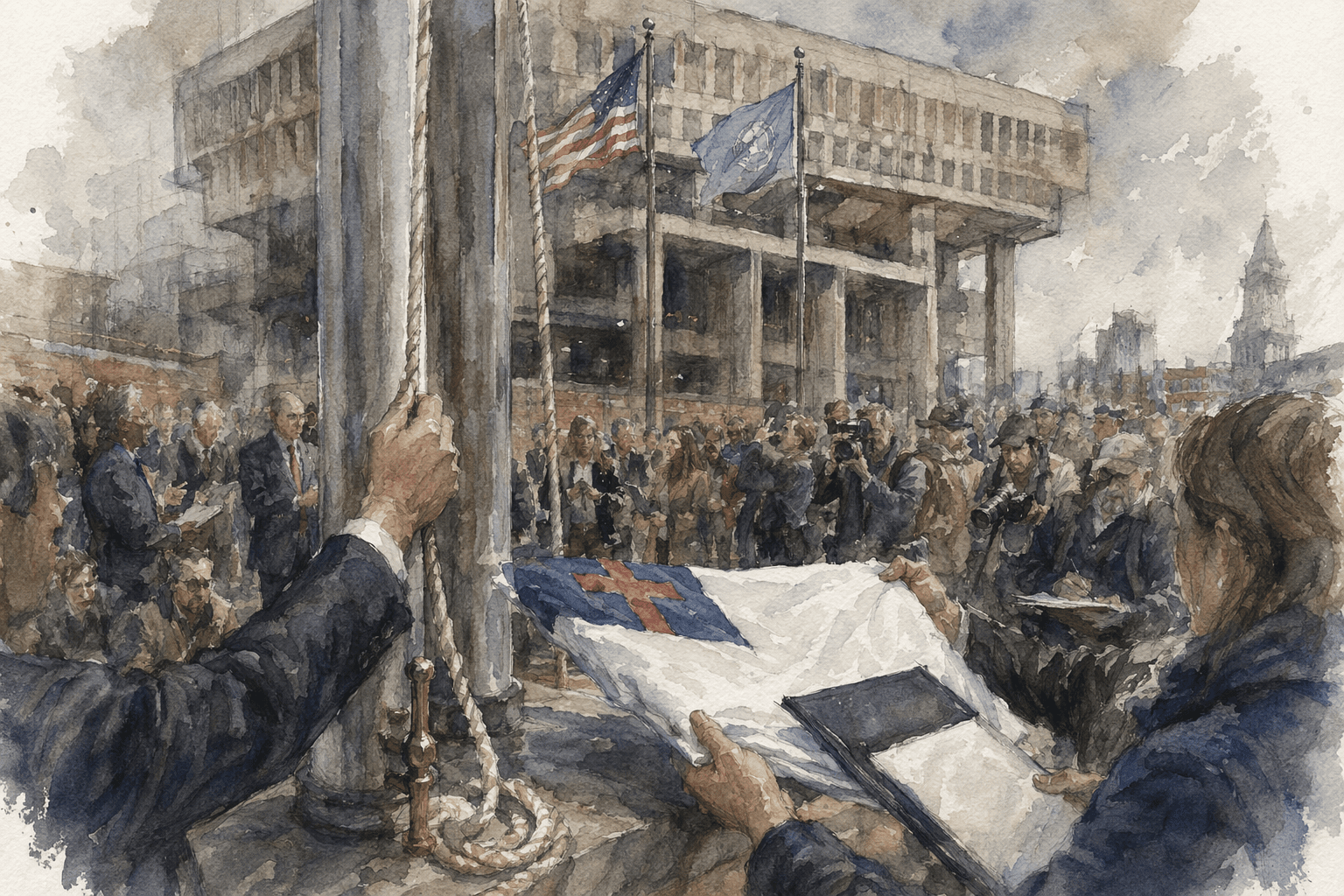
The Supreme Court sided with Camp Constitution, finding Boston violated the First Amendment by rejecting its Christian flag because it expressed a religious viewpoint, and sent the case back to the First Circuit.
- Where it stands
- Decided
Decided 9-0 · May 2, 2022 · Opinion by Justice Breyer
- What it’s about
- The Supreme Court decided that Boston’s flag-raising program was not government speech, so the city violated the First Amendment by refusing Camp Constitution’s request to fly a Christian flag because of its religious viewpoint.
- Who it affects
- Because Boston’s program was open to private groups, the city could not exclude their speech solely because it expressed a religious viewpoint. The First Circuit must now apply that rule as the case continues.
Summary: written with AI from the case record.
What it's about
The Court overturned the First Circuit’s ruling and sent the case back to the lower court (reversed and remanded).
The decision reinforces that when government opens a program to private speakers, it cannot treat religious viewpoints worse than other viewpoints.
Question presented
1. Whether the First Circuit ’ s failure to apply this Court ’ s forum doctrine to the First Amendment challenge of a private religious organization that was denied access to briefly display its flag on a city flagpole, pursuant to a city policy expressly designating the flagpole a public forum open to all applicants, with hundreds of approvals and no denials, conflicts with this Court ’ s precedents holding that speech restrictions based on religious viewpoint or content violate the First Amendment or are otherwise subject to strict scrutiny and that the Establishment Clause is not a defense to censorship of private speech in a public forum open to all comers. 2. Whether the First Circuit ’ s classifying as government speech the brief display of a private religious organization ’ s flag on a city flagpole, pursuant to a city policy expressly designating the flagpole a public forum open to all applicants, with hundreds of approvals and no denials, unconstitutionally?
What the Court decided
Holding
Boston’s flag-raising program does not express government speech. Because the flag-raising program did not express government speech, Boston’s refusal to let petitioners fly their flag violated the Free Speech Clause of the First Amendment. When the government does not speak for itself, it may not exclude private speech based on “religious viewpoint”; doing so “constitutes impermissible viewpoint discrimination.” Good News Club v. Milford Central School, 98, Boston concedes that it denied petitioners’ request out of Establishment Clause concerns, solely because the proposed flag “promot[ed] a specific religion.” App. to Pet. for Cert. 155a. 986 F. 3d 78, reversed and remanded.
- Result
- Reversed
The vote
- Joined the judgment
- Concurred in a separate opinion
- Wrote an opinion
- Majority · 6joined the Court's opinion
What's next
The case now returns to the First Circuit for further proceedings under the Supreme Court’s ruling.
Documents
Docket activity
New analysis added
AI analysis generated: Case Briefing
New analysis added
AI analysis generated: Impact Analysis
AI analysis generated: Opinion Summary
Show 6 moreShow fewer
AI analysis generated: Decision Record
Case data updated: summary, question_presented, generation_metadata
Case data updated: status, opinion_date
Opinion added: opinion
Brief added: Petition
Brief added: Questions Presented
More questions
- What did Shurtleff v. Boston decide?
- The Court said Boston’s program was not the city’s own speech, so refusing Camp Constitution’s Christian flag because of religion violated free speech.
- What led Boston to reject Camp Constitution’s flag?
- Boston said the flag’s religious message raised concerns under the Establishment Clause, the First Amendment’s rule against government establishing religion.
- What does the ruling mean for Boston’s flag program?
- Boston cannot exclude speech by private groups from the open program solely because it expresses a religious viewpoint.
- What happens next in Shurtleff v. Boston?
- The case returns to the First Circuit. That court must continue the proceedings under the Supreme Court’s ruling.
Sources
Primary materials plus reporting. Best-effort analysis: this explainer relies on a mix of primary materials and trusted secondary sources. Official filings and opinions remain authoritative.