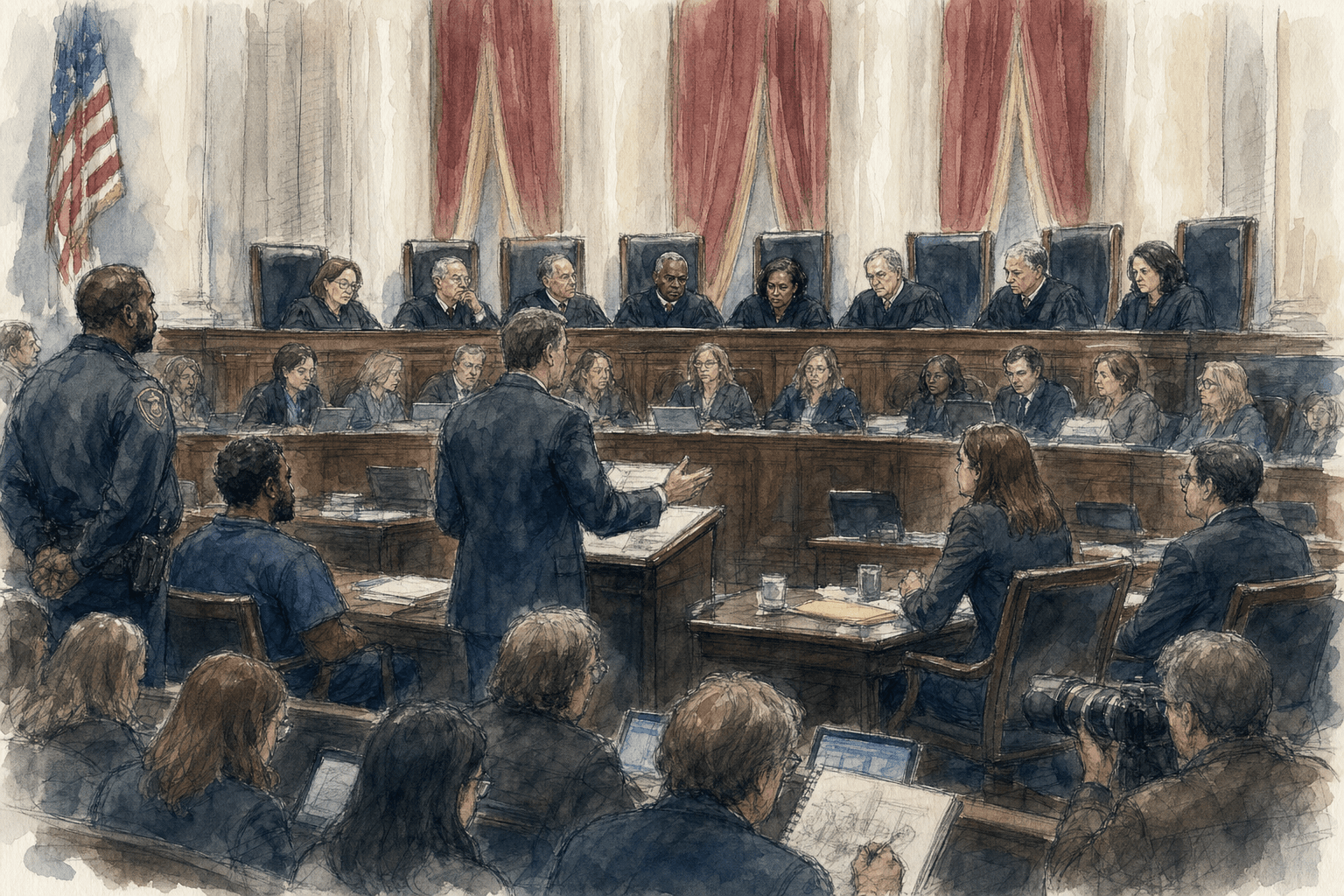
No. 17-1672October Term 2018Decided Jun 26, 2019
United States v. Haymond
The Court said Congress could not require this extra prison term based only on a judge's factual finding under this supervised-release provision.
Case status
- Current stage
- Decided
- Latest event
- Decision released Jun 26, 2019
- What it's about
This case asked whether a federal supervised-release law could require a judge to send a defendant back to prison for at least five years based on the judge’s own finding, by a preponderance of the evidence, that the defendant committed certain new conduct. It arose after Andre Haymond, who had been convicted of possessing child pornography, was found while on supervised release to have knowingly possessed child pornography again.
Question presented
Whether the court of appeals erred in holding "unconstitutional and unenforceable" the portions of 18 U.S.C. 3583(k) that required the district court to revoke respondent's ten-year term of supervised release, and to impose five years of reimprisonment, following its finding by a preponderance of the evidence that respondent violated the conditions of his release by knowingly possessing child pornography.
- Case path
United States Court of Appeals for the Tenth Circuit / Decision released Jun 26, 2019
- Area
Decided Supreme Court case
Briefing
What it's about
The case asked whether a federal supervised-release law could require at least five years of prison based on a judge's own finding, using a preponderance-of-the-evidence standard. On June 26, 2019, the Supreme Court said that part of 18 U.S.C. 3583(k) violated the right to a trial by jury.
Vote
The case was argued on February 26, 2019, and decided on June 26, 2019. The prompt does not provide the vote count, opinion author, or lineup.
Impact
The decision limits when judges can send someone on supervised release back to prison for a long mandatory term without a jury verdict. It affects federal defendants accused of certain new conduct while under court supervision.
What's next
The Supreme Court has finished this docket action. The decision left the lower courts to apply the ruling to Haymond and similar supervised-release cases.
What was the main fight in United States v. Haymond?
The dispute was over whether a judge could impose at least five more years in prison after finding new conduct by a lower proof standard. The Court said that feature of Section 3583(k) violated the jury-trial right.
Who is most affected by this decision in real life?
Federal defendants on supervised release are most directly affected. Judges cannot use this provision to impose a mandatory five-year prison term based only on their own fact-finding.
What happened next after the Supreme Court's decision?
The Supreme Court's work in this case ended on June 26, 2019. Lower courts then had to carry out and apply that decision in Haymond's case and others.
Decision
What the Court decided
The Court said Congress could not require this extra prison term based only on a judge's factual finding under this supervised-release provision.
Impact
The decision limits when judges can send someone on supervised release back to prison for a long mandatory term without a jury verdict. It affects federal defendants accused of certain new conduct while under court supervision.
Not official Court text.
Opinion documents
Related cases


Grounding
- Grounding
- Primary materials plus reporting.
- Note
- Best-effort analysis: this explainer relies on a mix of primary materials and trusted secondary sources. Official filings and opinions remain authoritative.
- Checked
- Jun 1, 2026
- Method
- Methodology
Primary materials10
Supreme Court docket 17-1672
docket | Jun 1, 2026
Primary case document
Supreme Court document | Jun 1, 2026
CourtListener docket record
docket | Jun 1, 2026
Questions Presented
brief | May 24, 2026
opinion
opinion | Jun 26, 2019
Petition
brief | Jun 15, 2018
SupremeCourt.gov
official | Jun 1, 2026
SupremeCourt.gov
official | Jun 1, 2026
SupremeCourt.gov
official | Jun 1, 2026
SupremeCourt.gov
official | Jun 1, 2026