Union access to private land
Cedar Point Nursery v. Hassid
In brief
The Court said California’s temporary union-access rule is a physical taking requiring payment, then overturned the Ninth Circuit’s ruling (reversed) and sent the case back to that court (remanded).
- Where it stands
- Decided
Decided 6-3 · June 23, 2021 · Opinion by Justice Kavanaugh
- What it’s about
- The Supreme Court overturned the Ninth Circuit’s ruling and sent the case back to that court (reversed and remanded), deciding that California’s rule allowing union organizers limited access to Cedar Point Nursery’s property is a per se physical taking (a government appropriation of property requiring payment under the Fifth Amendment).
- Who it affects
- The Court treated California’s temporary access requirement as a taking of growers’ right to exclude others, even though access is temporary. That means the Fifth Amendment’s payment requirement applies.
Summary: written with AI from the case record.
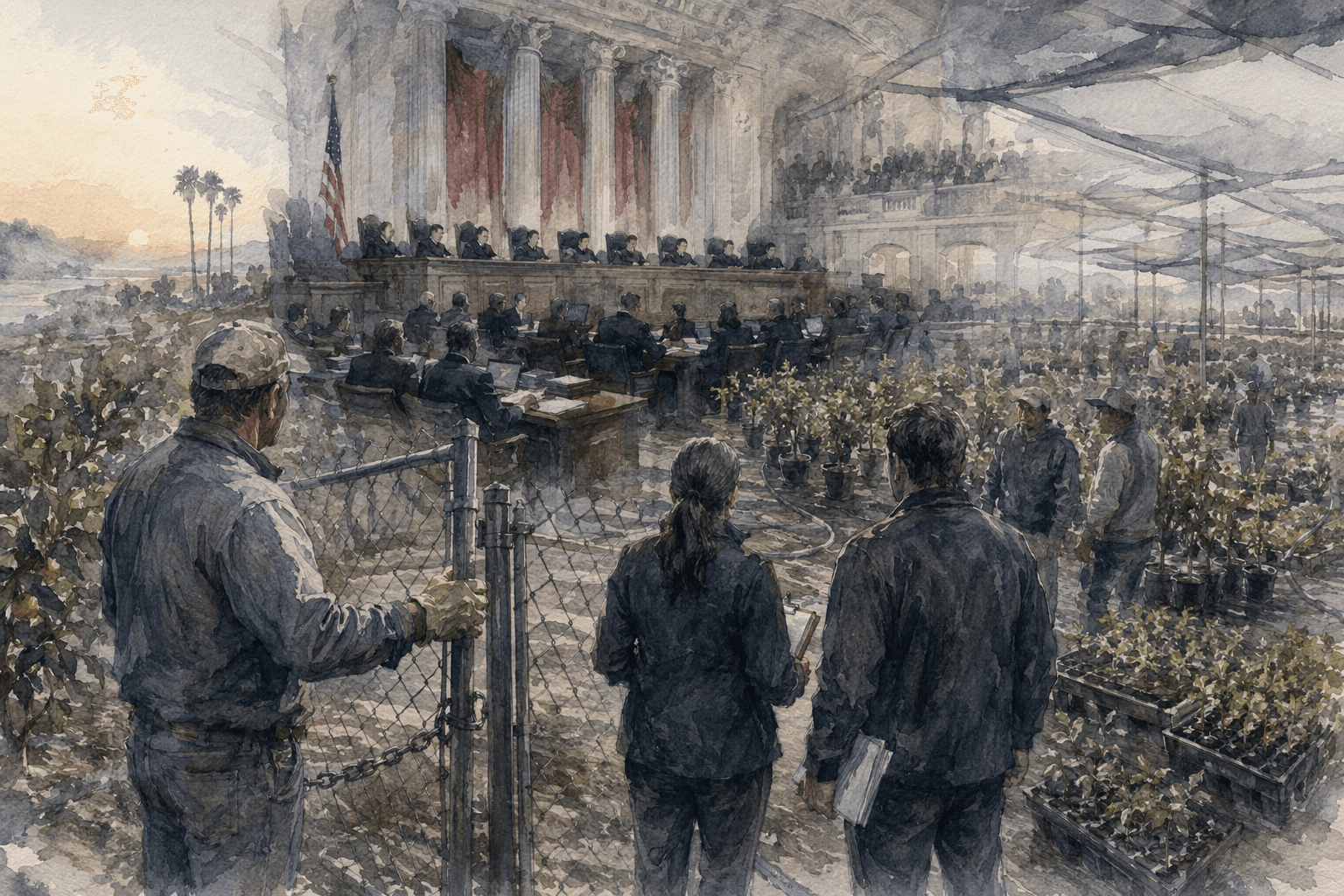
What it's about
The Court said the rule takes growers’ right to exclude others, even though access is temporary.
The case addresses when government-required entry onto private land becomes a physical taking instead of an ordinary property regulation.
Question presented
Whether the uncompensated appropriation of an easement that is limited in time effects a per se physical taking under the Fifth Amendment.
What the Court decided
Holding
California’s access regulation constitutes a per se physical taking. 923 F. 3d 524, reversed and remanded.
- Result
- Reversed
The vote
From the opinions
“Does the regulation physically appropriate the employers’ property? If so, there is no need to look further; the Government must pay the employers “just compensation.””
What's next
The Ninth Circuit will take up the case again under the Supreme Court’s ruling. The lower court will handle the case-specific consequences, including any compensation proceedings, after the case was sent back (remanded).
Documents
Docket activity
New analysis added
AI analysis generated: Case Briefing
New analysis added
AI analysis generated: Impact Analysis
AI analysis generated: Opinion Summary
Show 6 moreShow fewer
AI analysis generated: Decision Record
Case data updated: summary, question_presented, generation_metadata
Case data updated: status, opinion_date
Opinion added: opinion
Brief added: Petition
Brief added: Questions Presented
More questions
- What did the Supreme Court decide in Cedar Point Nursery?
- It decided that California’s temporary union-access rule is a physical taking requiring payment under the Fifth Amendment.
- What practical effect does the ruling have for California growers?
- It treats California’s required access as a government taking of growers’ right to exclude others, even though access is temporary. The Fifth Amendment’s payment requirement applies.
- What happens next in Cedar Point Nursery?
- The Ninth Circuit will take up the case again under the Supreme Court’s ruling after the case was sent back (remanded).
Sources
Primary materials plus reporting. Best-effort analysis: this explainer relies on a mix of primary materials and trusted secondary sources. Official filings and opinions remain authoritative.