Traffic stops and dog searches
Rodriguez v. United States
In brief
Police cannot prolong a traffic stop for a dog sniff without reasonable suspicion, but the Eighth Circuit must still decide whether the officer had it in Rodriguez’s case.
- Where it stands
- Decided
Decided 6-3 · April 21, 2015 · Opinion by Justice Ginsburg
- What it’s about
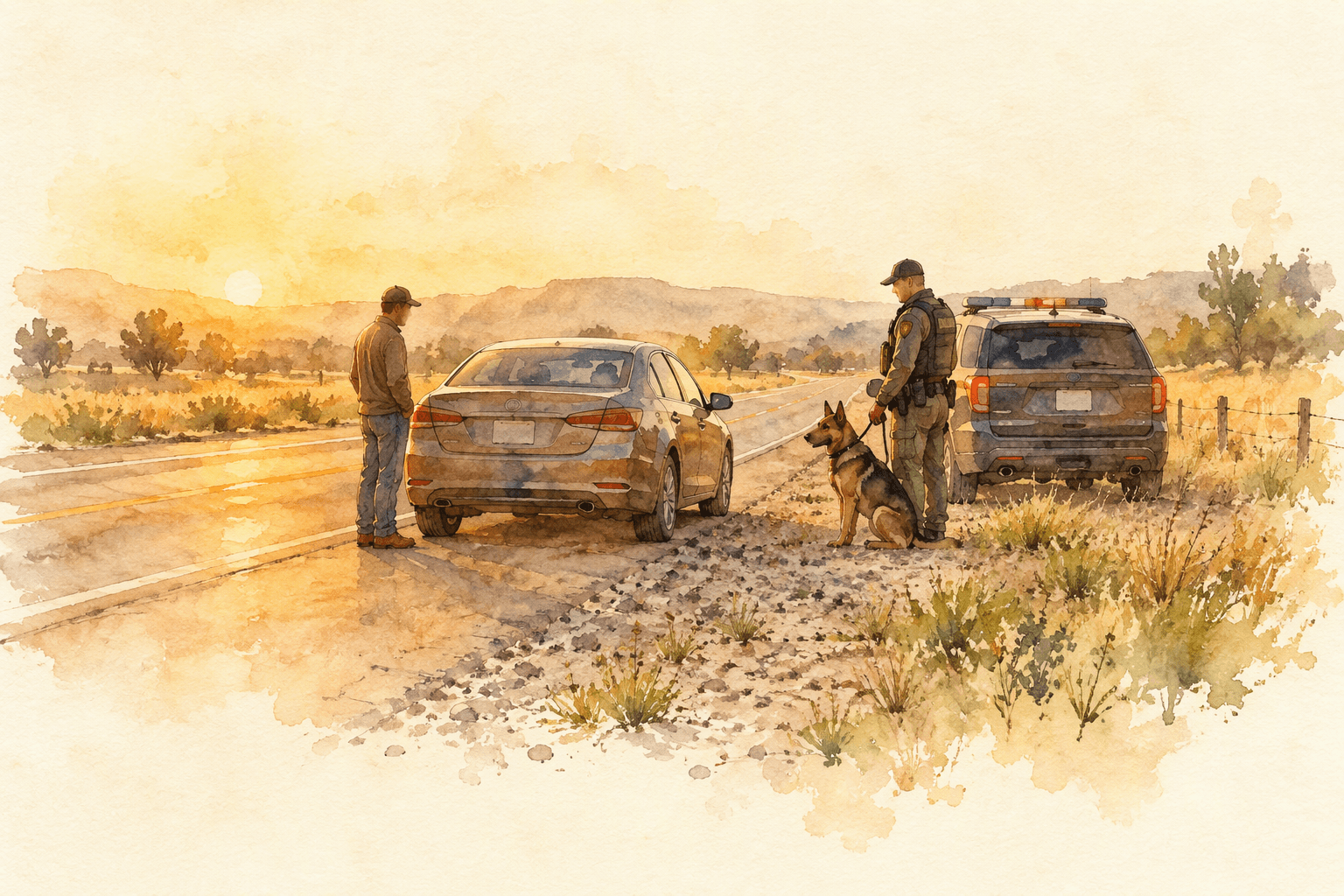
- The Supreme Court ruled that police may not extend Dennys Rodriguez’s traffic stop for a dog sniff without reasonable suspicion.
- Who it affects
- The rule limits police authority to prolong traffic stops for dog sniffs; whether the officer had grounds to keep Rodriguez stopped remains unresolved.
Summary: written with AI from the case record.
What it's about
It wiped out the appeals court’s ruling (vacated it) and sent the case back to the lower court (remanded), leaving open whether the officer had reasonable suspicion in Rodriguez’s case.
Justice Thomas, who disagreed with the Court, described a 29-minute stop; he said the officer had issued Rodriguez a written warning and a backup unit had arrived before the dog sniff.
The Fourth Amendment bars unreasonable seizures, and this case concerns how that protection limits the length of routine traffic stops.
Question presented
Is the use of a K-9 unit, after the conclusion of a traffic stop and without reasonable suspicion of criminal activity, a violation of the Fourth Amendment prohibition on unreasonable search and seizures?
What the Court decided
Holding
1. Absent reasonable suspicion, police extension of a traffic stop in order to conduct a dog sniff violates the Constitution’s shield against unreasonable seizures. A routine traffic stop is more like a brief stop under Terry v. Ohio, 392 U. S. 1, than an arrest, see, e.g., Arizona v. Johnson, 555 U. S. 323, 330. Its tolerable duration is determined by the seizure’s “mission,” which is to address the traffic violation that warranted the stop, Illinois v. Caballes, 543 U. S. 405, 407 and attend to related safety concerns. Authority for the seizure ends when tasks tied to the traffic infraction are—or reasonably should have been— completed. 2. The determination adopted by the District Court that detention for the dog sniff was not independently supported by individualized suspicion was not reviewed by the Eighth Circuit. That question therefore remains open for consideration on remand. 741 F. 3d 905, vacated and remanded.
- Result
- Vacated
The Court's reasoning
The Court said a stop is limited to addressing the traffic violation and related safety concerns. Once those tasks are done, or reasonably should be done, police need grounds to suspect other criminal activity to keep the driver stopped for a dog sniff.
The vote
From the opinions
“Because the stop was reasonably executed, no Fourth Amendment violation occurred.”
What's next
The case returns to the Eighth Circuit, which must consider whether the officer had reasonable suspicion to keep Rodriguez stopped for the dog sniff.
Documents
Opinions
Docket activity
New analysis added
AI analysis generated: Case Briefing
New analysis added
AI analysis generated: Impact Analysis
AI analysis generated: Opinion Summary
Show 5 moreShow fewer
New analysis added
AI analysis generated: Decision Record
Case data updated: summary, question_presented, generation_metadata
Case data updated: question_presented, extraction_metadata
Opinion added: Rodriguez
Sources
Primary materials plus reporting. Best-effort analysis: this explainer relies on a mix of primary materials and trusted secondary sources. Official filings and opinions remain authoritative.