Partisan election maps
Rucho v. Cause
In brief
The Supreme Court wiped out the lower court's ruling and sent the case back, while deciding that federal courts cannot decide partisan-gerrymandering claims.
- Where it stands
- Decided
Decided 5-4 · June 27, 2019 · Opinion by Chief Justice Roberts
- What it’s about
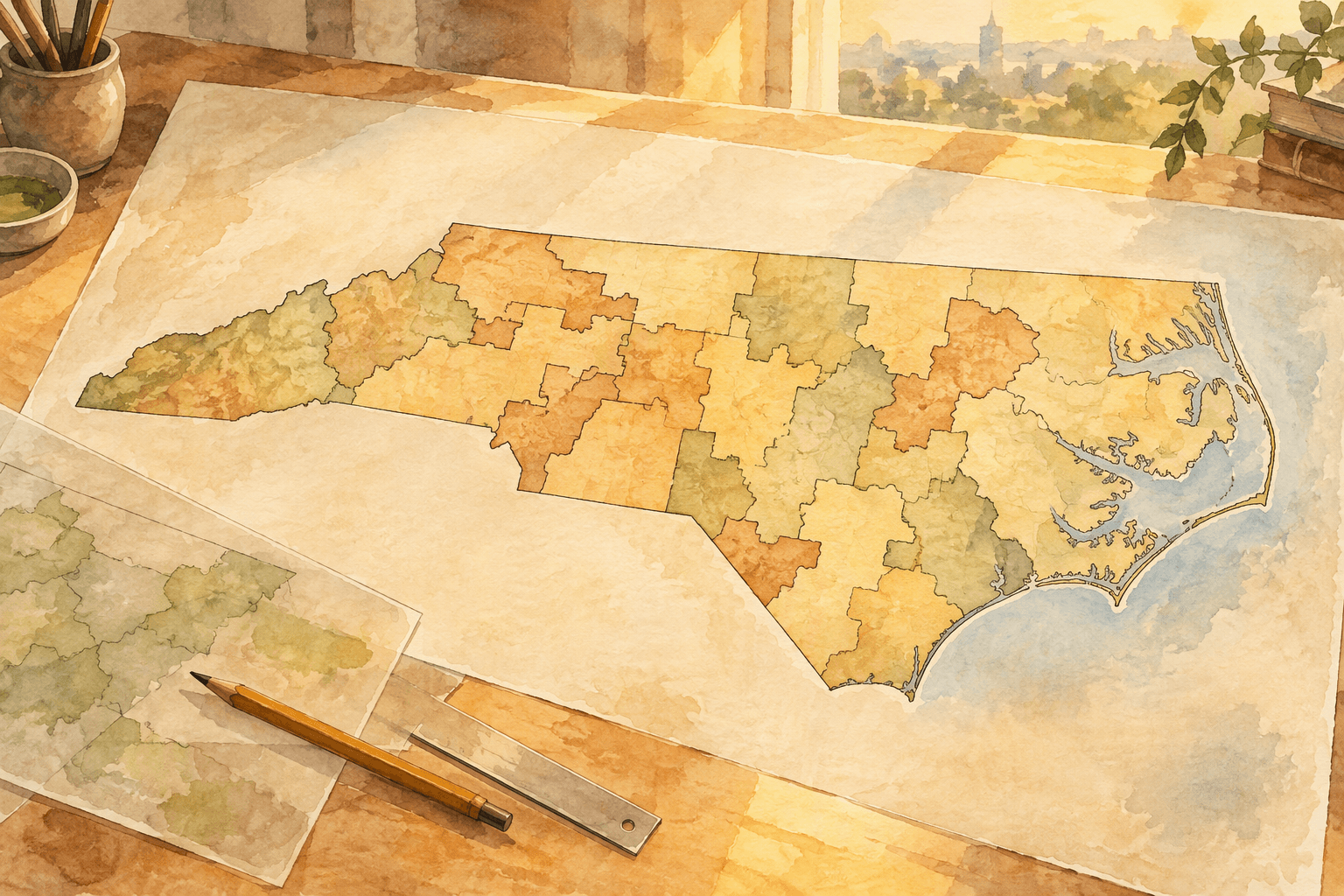
- North Carolina lawmakers appealed after a federal court struck down the state’s 2016 congressional map as a partisan gerrymander.
- Who it affects
- Federal courts cannot decide the challenge to North Carolina's 2016 map as a partisan gerrymander.
Summary: written with AI from the case record.
What it's about
The Supreme Court ruled that federal courts cannot decide partisan-gerrymandering claims, wiped out the lower court’s ruling (vacated it), and sent the case back (remanded it).
The federal district court had ruled that the 2016 map was unconstitutional as a partisan gerrymander; North Carolina lawmakers appealed.
The central dispute was when political mapmaking to favor a party goes too far under the Constitution.
Question presented
1. Whether plaintiffs have standing to press their partisan gerrymandering claims. 2. Whether plaintiffs' partisan gerrymandering claims are justiciable. 3. Whether North Carolina's 2016 congressional map is, in fact, an unconstitutional partisan gerrymander.
What the Court decided
Holding
Partisan gerrymandering claims present political questions beyond the reach of the federal courts. 318 F. Supp. 3d 777 and 348 F. Supp. 3d 493, vacated and remanded.
- Result
- Vacated
The Court's reasoning
The Court said these claims raise political questions, meaning issues federal courts cannot decide.
The vote
From the opinions
“For the first time ever, this Court refuses to remedy a constitutional violation because it thinks the task beyond judicial capabilities.”
What's next
The case returns to the federal district court. The Supreme Court's ruling bars federal courts from deciding the partisan-gerrymandering claim.
Docket activity
New analysis added
AI analysis generated: Case Briefing
AI analysis generated: Decision Record
Case data updated: summary, question_presented, generation_metadata
Case data updated: question_presented, extraction_metadata
Show 3 moreShow fewer
Opinion added: opinion
Brief added: Jurisdictional Statement
Brief added: Questions Presented
More questions
- Did the Court decide whether North Carolina's map was unconstitutional?
- No. The Court said federal courts cannot decide partisan-gerrymandering claims; it did not decide whether the map itself was unconstitutional.
Sources
Primary materials plus reporting. Best-effort analysis: this explainer relies on a mix of primary materials and trusted secondary sources. Official filings and opinions remain authoritative.