Race-based voting maps
Louisiana v. Callais
In brief
Louisiana's second majority-Black congressional district was unconstitutional because federal law did not require it.
- Where it stands
- Decided
Decided 6-3 · April 29, 2026 · Opinion by Justice Alito
- What it’s about
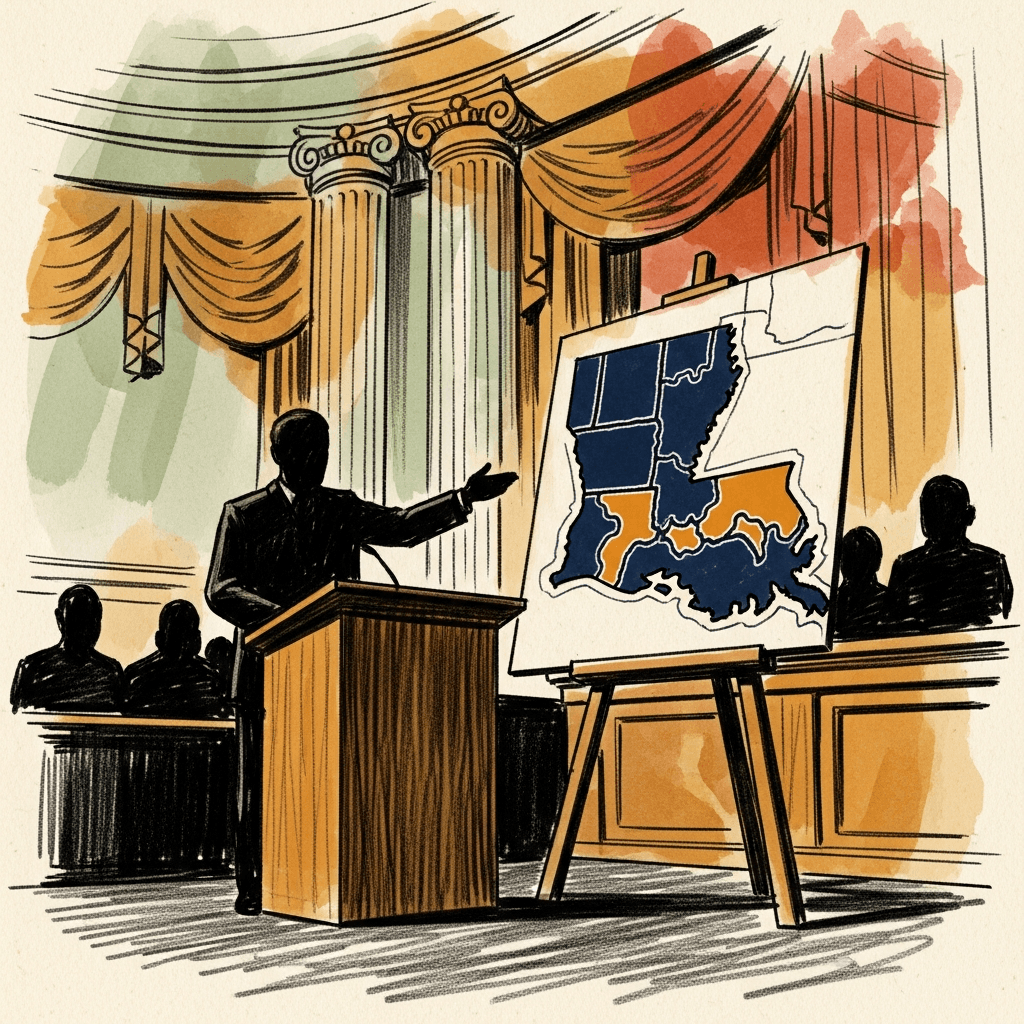
- The Court decided Louisiana v. Callais on April 29, 2026, affirming and remanding a ruling that struck down Louisiana's SB8 congressional map as an unconstitutional racial gerrymander.
- Who it affects
- Louisiana voters and congressional candidates may face a replacement map because SB8 was struck down. The decision limits when states may use race to draw districts in response to federal voting-rights concerns.
Summary: written with AI from the case record.
What it's about
The Court held that Section 2 of the Voting Rights Act, properly construed, did not require Louisiana to create an additional majority-minority district, so the state had no compelling interest for using race to draw District 6.
The case addresses the boundary between enforcing federal voting-rights protections and racial gerrymandering (drawing voting districts mainly based on race).
Question presented
Does Louisiana’s creation of a second majority-Black congressional district constitute unconstitutional racial gerrymandering, even when drawn in response to a federal court finding that the state’s prior single majority-Black district likely violated Section 2 of the Voting Rights Act?
What the Court decided
The vote
- Joined the judgment
- Concurred in a separate opinion
- Dissented
- Wrote an opinion
- Concurring · 1agreed with the result, wrote separately
- Thomaswrote separately
What's next
The case returns to the lower court for further proceedings after the SB8 map was invalidated. Louisiana officials and affected parties will need to address a replacement congressional map.
Docket activity
New analysis added
AI analysis generated: Impact Analysis
AI analysis generated: Opinion Summary
New analysis added
AI analysis generated: Case Briefing
Show 7 moreShow fewer
New analysis added
New analysis added
Opinion added: Opinion of the Court - A
Argued. For appellants Press Robinson, et al.: Janai Nelson, New York, N. Y. For appellant Louisiana: J. Benjamin Aguiñaga, Solicitor General, Baton Rouge, La. For appellees: Edward D. Greim, Kansas City, Mo. For United States, as amicus curiae, in support of appellees: Hashim M. Mooppan, Principal Deputy Solicitor General, Department of Justice, Washington, D. C. VIDED.
These cases are restored to the calendar for reargument. In due course, the Court will issue an order scheduling argument and specifying any additional questions to be addressed in supplemental briefing. Justice Thomas, dissenting. VIDED.
Opinion added: Opinion
Argued. For appellant in 24-109: J. Benjamin Aguiñaga, Solicitor General, Baton Rouge, La. For appellants in 24-110: Stuart C. Naifeh, New York, N. Y. For appellees: Edward D. Greim, Kansas City, Mo. VIDED.
More questions
- What did the Supreme Court rule in Louisiana v. Callais?
- The Court affirmed the decision striking down Louisiana's SB8 map. It said federal voting-rights law did not require the additional majority-Black district.
- Who is affected by the Callais decision?
- Louisiana voters and congressional candidates are affected because the invalidated map included District 6. State officials may need to use a replacement map.
- What happens next after Louisiana v. Callais?
- The case returns to the lower court for further proceedings. Louisiana officials and affected parties must address how to replace the invalidated congressional map.
Sources
Primary materials plus reporting. Best-effort analysis: this explainer relies on a mix of primary materials and trusted secondary sources. Official filings and opinions remain authoritative.