Maryland v. Alonzo Jay King, Jr.
In brief
The Supreme Court overturned Maryland's ruling and allowed DNA cheek swabs during booking when police have a legal basis to arrest someone for a serious offense and bring that person in for custody.
- Where it stands
- Decided
Decided 5-4 · June 3, 2013 · Opinion by Justice Kennedy
- What it’s about
- The Supreme Court held that law enforcement officers can constitutionally collect DNA samples from individuals arrested for serious crimes as part of routine booking procedures.
- Who it affects
- The ruling permits cheek-swab DNA collection during booking for people arrested on a legal basis for a serious offense and brought in for custody.
Summary: written with AI from the case record.
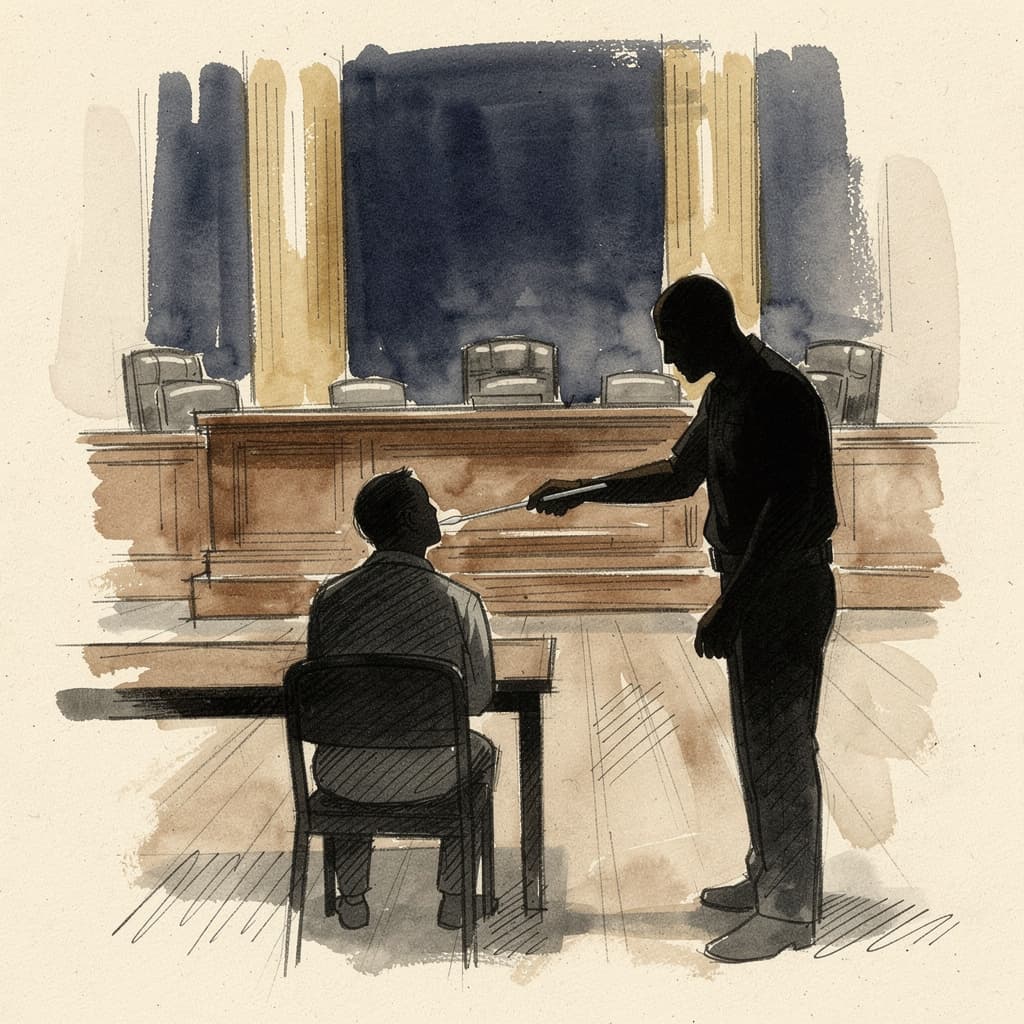
What it's about
The Court ruled that this practice serves a legitimate state interest and does not violate the Fourth Amendment.
Maryland's policy allowed DNA collection from people arrested for serious crimes before they were convicted.
Question presented
Does the Fourth Amendment allow states to collect and analyze DNA from people arrested, but not convicted, of serious crimes?
What the Court decided
Holding
When officers make an arrest supported by probable cause to hold for a serious offense and bring the suspect to the station to be detained in custody, taking and analyzing a cheek swab of the arrestee’s DNA is, like fingerprinting and photographing, a legitimate police booking procedure that is reasonable under the Fourth Amendment. 425 Md. 550, 42 A. 3d 549, reversed.
- Result
- Reversed
The Court's reasoning
The Court compared cheek-swab DNA testing to fingerprinting and photographs, treating it as a legitimate booking step under the Fourth Amendment when the arrest and custody conditions are met.
The vote
From the opinions
“Whenever this Court has allowed a suspicionless search, it has insisted upon a justifying motive apart from the investigation of crime.”
What's next
Police and courts applying the decision must follow its limits: the arrest must be supported by probable cause for a serious offense, and the person must be brought in for custody.
Documents
Docket activity
New analysis added
AI analysis generated: Case Briefing
New analysis added
AI analysis generated: Impact Analysis
AI analysis generated: Opinion Summary
Show 7 moreShow fewer
AI analysis generated: Decision Record
Case data updated: title, opinion_date
New analysis added
Case data updated: term, status, opinion_date
Audio Recording added: Oral Arguments - King
Opinion added: King
Brief added: Questions Presented
More questions
- What did Justice Scalia argue?
- He argued that police were using DNA to investigate crimes, not simply to identify people in custody.
Sources
Primary materials plus reporting. Best-effort analysis: this explainer relies on a mix of primary materials and trusted secondary sources. Official filings and opinions remain authoritative.