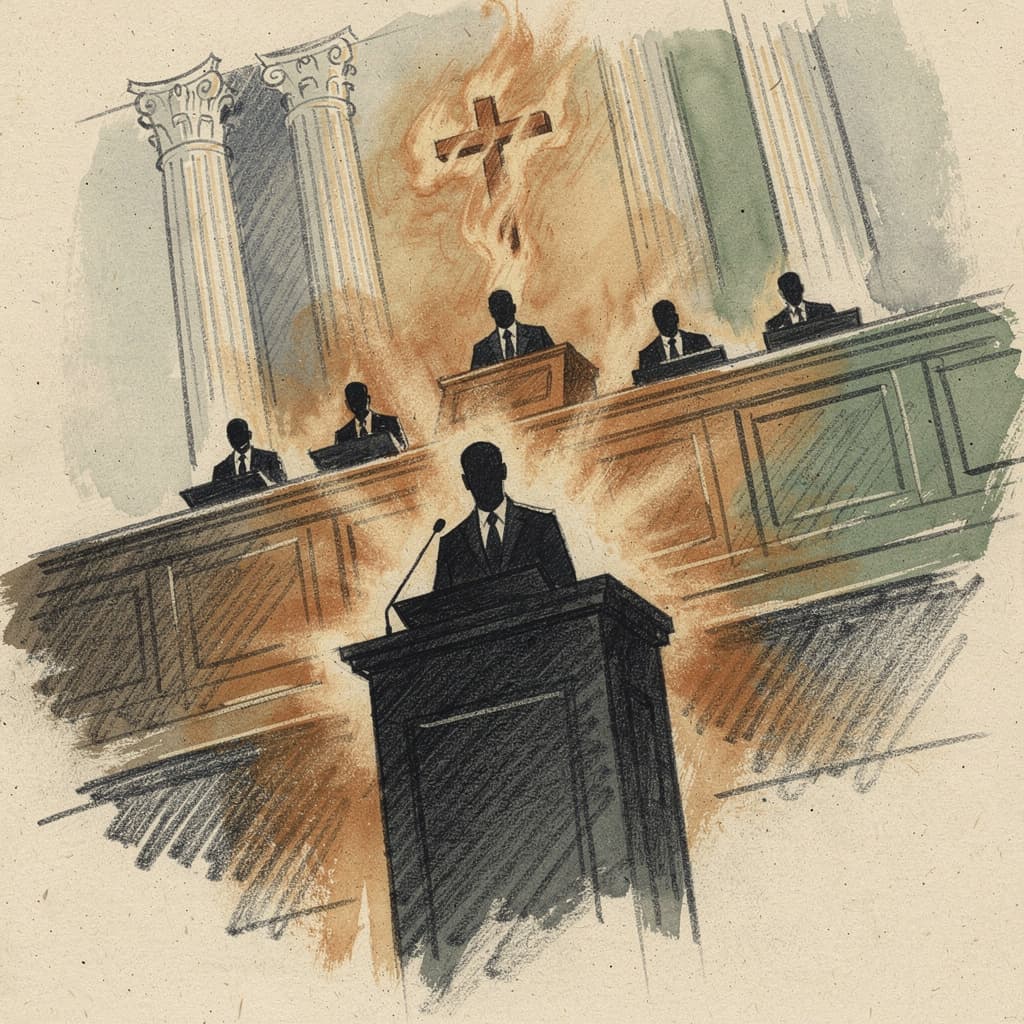
Virginia v. Black
Does the Commonwealth of Virginia's cross-burning statute, which prohibits the burning of a cross with the intent of intimidating any person or group of persons, violate the First Amendment?
- Status
- Decided
- Appeal from
- Supreme Court of Virginia
- Argued
- Dec 11, 2002
- Decision released
- Apr 7, 2003
Briefing
Did the Supreme Court allow Virginia to ban cross-burning as a form of intimidation?
The Court ruled that states can ban cross-burning if the act is done specifically to intimidate others. However, the Court struck down a part of Virginia's law that automatically assumed any cross-burning was intended to threaten someone. This means prosecutors must prove a person's specific intent to scare others rather than just showing the fire happened.
How does this ruling affect the balance between free speech and public safety?
This decision protects people from targeted threats while ensuring that the government does not punish speech too broadly. It means that even hateful symbols are protected by the First Amendment unless they are used as a direct 'true threat' against a person or group. For everyday people, this sets a high bar for what the government can call a crime in the context of protest or expression.
Where does cross-burning fit into the history of protected speech and racial terror?
Cross-burning has a long, violent history in the U.S. as a tool of racial terror used by groups like the Ku Klux Klan. The Court had to decide if this symbol is so uniquely dangerous that it loses all free speech protections. This case follows a tradition of the Court trying to define the exact line where speech turns into an illegal act of violence.
Why did the justices disagree on how to prove a person's intent to intimidate?
The Court reached a 7-2 decision. Justice O'Connor wrote the main opinion, joined by four other justices in the core holding, while Justice Thomas dissented, arguing the law was fully constitutional.
“a State, consistent with the First Amendment, may ban cross burning carried out with the intent to intimidate”
“Justice Thomas dissented, arguing that the statute was constitutional because cross-burning is a conduct-based threat rather than protected speech.”
What is the final rule for states trying to ban threatening symbols?
States may outlaw cross-burning meant to threaten people, but they cannot treat the act itself as automatic proof of a crime.
What happens to Virginia's law and future cases involving hateful symbols?
The case was sent back to the lower courts to determine if some of the defendants could be retried under a corrected version of the law. Virginia and other states must now ensure their laws require specific evidence of a threat. This ruling continues to guide how courts handle cases involving hate speech and 'true threats' today.
Why was the 'prima facie' evidence provision in the law considered unconstitutional?
The provision allowed a jury to assume a person intended to intimidate someone just because they burned a cross. The Court found this unconstitutional because it could lead to the conviction of people who burned crosses for reasons other than making a threat.
Who were the individuals involved in the original legal dispute?
The case involved Barry Black, Richard Elliott, and Jonathan O'Mara, who were convicted in separate incidents of burning crosses. Black led a KKK rally on private property, while Elliott and O'Mara burned a cross in a neighbor's yard.
How does the Court define a 'true threat' in this context?
A true threat occurs when a speaker directs a message toward a person or group with the intent of placing them in fear of bodily harm or death. Under this ruling, cross-burning only loses First Amendment protection when it meets this specific definition of a threat.
What was Justice Clarence Thomas's unique perspective on this case?
Justice Thomas was the lone dissenter who argued that cross-burning is not speech at all, but rather a physical act of terror. He believed the Virginia law should be upheld entirely because of the symbol's history of association with violence.
Can a person still be arrested for burning a cross in Virginia?
Yes, but only if the government can prove the person did it to intimidate someone. The ruling does not protect cross-burning used as a threat, but it prevents the state from using a shortcut to prove that threat in court.
Timeline
Sources
Docket plus reporting.
Refreshed Mar 31, 2026.
Context reporting
Coverage
Related cases