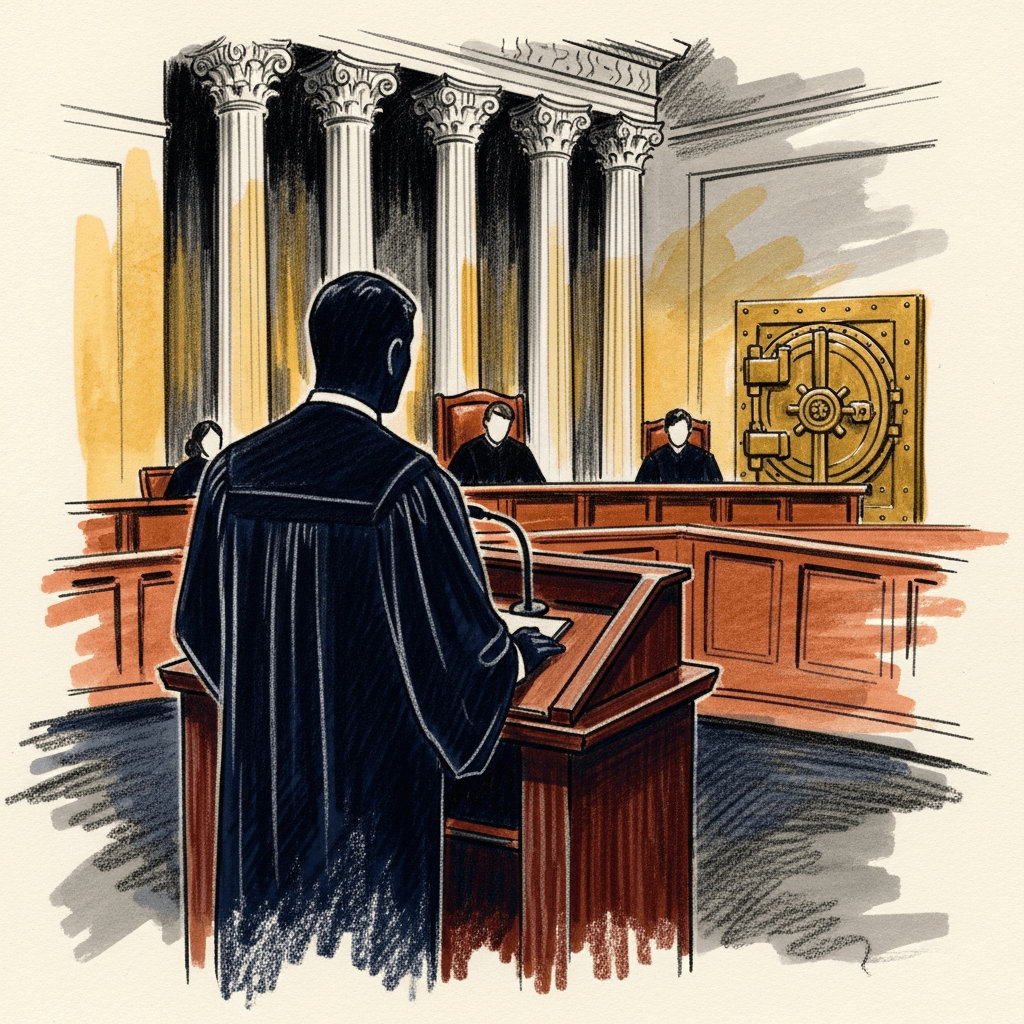
Hines v. Regions Bank
Hines filed a petition for a writ of certiorari to the Supreme Court regarding a decision by the Eleventh Circuit involving Regions Bank, but the case was ultimately dismissed.
- Status
- Dismissed
- Appeal from
- United States Court of Appeals for the Eleventh Circuit
Case briefing
Case snapshot
What Happened
A petitioner named Hines asked the Supreme Court to decide if a company can be sued in a state just because it registered to do business there. The case focuses on whether this practice violates the Due Process Clause (a rule ensuring legal fairness) of the Fourteenth Amendment. The Eleventh Circuit Court of Appeals previously handled the dispute before it was brought to the high court.
Why It Matters
This case could change where people are allowed to sue large corporations for legal disputes. If the Court allows these lawsuits, companies might face legal battles in many different states instead of just where they are based. This affects any person or business trying to hold a national corporation accountable in a local court.
The Big Picture
The Supreme Court is looking at the limits of 'general personal jurisdiction' (a court's power to hear any case against a person or company). For years, the Court has limited where companies can be sued to protect them from being dragged into distant courts. This case tests whether simply signing up to do business in a state counts as giving up those protections.
What the Justices Said
No substantive justice or advocate reactions are available yet.
The Bottom Line
The Court must decide if registering a business in a state automatically gives that state's courts power over the company.
What's Next
The case is currently pending, and the next major step would typically be oral arguments or a scheduling update. However, records indicate the petition was ultimately dismissed, meaning the lower court's ruling remains in place. No further hearings are currently scheduled for this specific matter.
What is the core dispute in this case?
The case asks if a company's registration to do business in a state allows that state to have legal power over them. It centers on whether this violates constitutional rules about fairness.
What are the real-world consequences for consumers?
If the Court rules against the bank, consumers could sue national companies in their home states more easily. Otherwise, people might have to travel to a company's headquarters to file a lawsuit.
What legal rule is being tested here?
The case tests the Due Process Clause of the Fourteenth Amendment. It examines if 'general personal jurisdiction' (broad court authority) can be based solely on business registration.
What is the next procedural step for this case?
The case was dismissed after the petition for certiorari (a request for the Court to hear the case) was filed. No further oral arguments or rulings are expected from the Supreme Court.
How does this fit into a broader legal trend?
The Supreme Court has recently been narrowing where corporations can be sued. This case follows a trend of defining the exact boundaries of a state's power over out-of-state businesses.
Where things stand
Timeline
Source note
How this page is sourced
Official case materials anchor this page. Reporting is used only to add context and explain the dispute in plain English.
Page data last refreshed Mar 30, 2026.
Context reporting
Primary materials
Documents & resources
Key filings
Recent coverage
In the news
More to watch